
- Knowledge Centre
Why top coaches are using emotional intelligence
...And Why You Should Too!
You can read the books, understand the theory and talk impressively about emotional intelligence without being particularly effective at helping a client develop it.
That is an uncomfortable distinction. It is also an important one.
In my experience, too much coaching takes a generalised approach to emotional intelligence. The coach can explain why self-awareness matters, why empathy is useful and why managing emotions is important. But when a client asks, “How do I actually change what happens when I’m under pressure?”, the answer becomes less convincing.
The value of emotional intelligence is not in how confidently you discuss it. It is in how effectively you help someone apply it.
That is why I believe coaches who want to deliver exceptional value need to move beyond familiarity with the subject. They need depth, practical skill and a willingness to examine their own emotional intelligence, not just their clients’.
Knowing about emotional intelligence is not the same as coaching it
Popular books can provide a useful introduction. Academic understanding matters too. But neither automatically equips a coach to identify what is happening for a particular client or build a meaningful development plan.
The deeper work involves understanding how specific emotional intelligence competencies interact.
Some competencies when in balance, support one another. Others, when out of balance, can contribute to thinking, behaviour and communication that undermines the client’s intentions.
A coach needs to explore those relationships, understand their implications and help the client practise different responses in real situations.
For me, that means being able to answer questions such as:
Which emotional intelligence competencies appear relevant to this client’s most pressing challenge and most important goal?
How might those specific competencies be supporting, or working against, one another?
What does that combination look like in the client’s everyday decisions and communication?
What will the client practise differently between sessions to create and maintain a more balanced way of thinking, communicating and behaving?
How will we establish whether their behaviour and impact are changing, at all or at what speed?
If we cannot move from explanation to application, we risk giving clients an interesting conversation of little if any value, rather than valuable coaching which delivers immense value.
Why “count to ten” is not a development plan
Consider an executive who becomes impulsive and aggressive in conversations when the pressure or tension increases.
A generalised coaching response might be to recommend pausing before speaking, counting to ten or taking a deep breath.
My objection is not to the idea of a pause. It is to presenting a generic tactic as though it adequately addresses a pattern that has not been properly explored.
What is happening in their brain, their body, their internal dialogue, before the executive speaks? What makes their response more likely? Why does their communication become forceful in some situations but not others?
In the example I use when explaining this to coaches, low impulse control, high assertiveness and low stress tolerance may combine to create a “jump before you look” approach to communication.
The executive may not consciously intend to cause harm or force compliance or agreement. Nevertheless, their colleagues experience the consequences.
Telling that executive to “be less aggressive” describes the desired outcome. It does not provide a sufficiently specific route towards it.
Look at the combination, not just the behaviour
I use the EQ-i 2.0 assessment to help bring structure to this exploration.
The work is not simply about identifying a high or low score. It involves understanding the relationships between competencies, discussing how those patterns show up in practice and agreeing meaningful development priorities. Understanding these relationships and facilitating assessment feedback are central parts of Summit’s EQ-i 2.0 certification curriculum.
The assessment is a starting point for a more focused coaching conversation. Not a substitute for one.
The practical questions then become: What does the client recognise? Where does this happen? What impact does it have? What will they do differently? How will they know they are responding differently?
That is how we move towards a proactive development plan rather than a collection of disconnected tips and crappy soundbites.
What this looked like with a senior financial services leader
One of our clients, referred to as just Duncan to protect confidentiality, led more than 100 technical specialists in a financial services business.
Within 15 weeks of his arrival, HR had received five formal complaints about his management style and communication. Two employees had resigned, with both departures attributed to his being in post. A leadership development course with a HR consultancy had not changed the pattern.
Duncan was not enthusiastic about coaching. He believed he had progressed without it and questioned why he needed it because other people struggled to take criticism. He agreed to complete an EQ-i 2.0 assessment, but initially showed little interest in the results.
The turning point was understanding how his competencies interacted
Duncan’s assessment showed high assertiveness alongside low empathy and low impulse control. It also highlighted low self-regard and emotional self-awareness, together with high independence and high stress tolerance.
That last point matters: Duncan’s pattern was not identical to the earlier example. His own comfort with pressure was part of the discussion about why he was slow to recognise pressure building in others. This was an individual coaching conversation, not a standard explanation applied to every forceful leader.
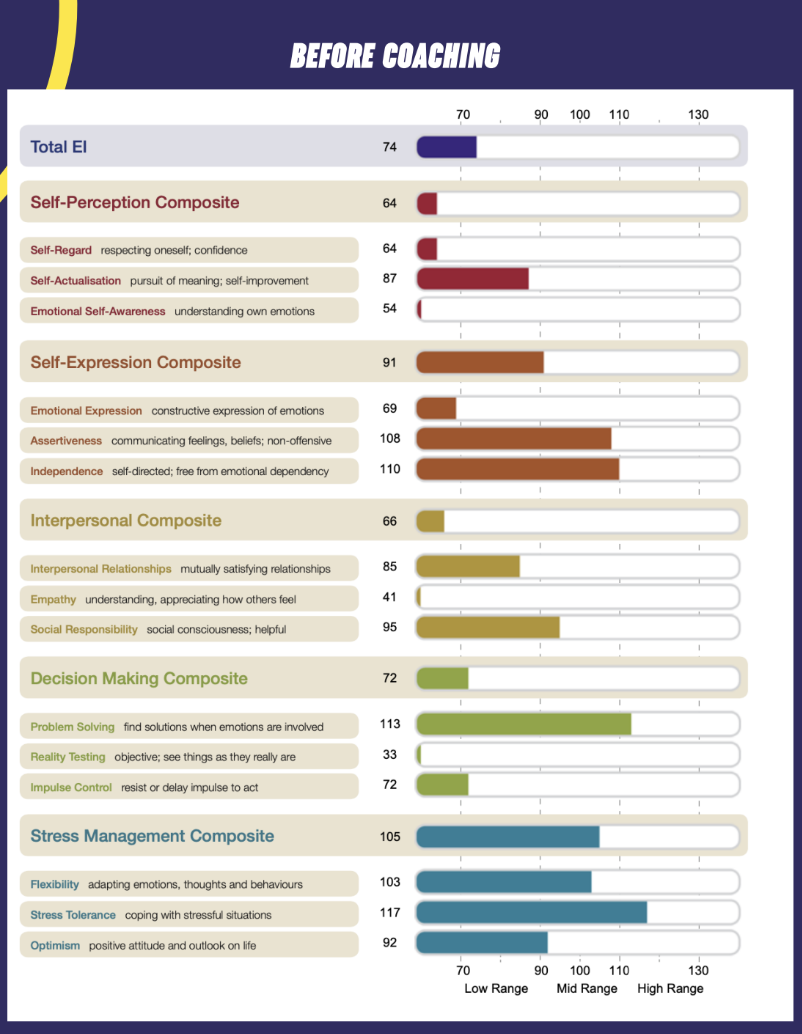 The turning point came when we explored how his scores worked together, including the relationship between low impulse control and high assertiveness. Duncan began connecting the assessment with his behaviour and its impact, and engaged more reflectively with the coaching.
Development happened between the sessions
Duncan attended seven weekly coaching sessions, each lasting 60 minutes, with specific development commitments to apply between meetings. The aim was not to turn him into someone else. It was to help him make healthier choices that supported trust, collaboration and team cohesion.
The changes included:
Considering his impact on others before acting.
Balancing assertiveness with a more empathetic, collaborative approach.
Recognising people’s positive contributions.
Planning projects more proactively.
Inviting direct reports to give candid feedback on his performance and impact.
At the seven-week reassessment, all his previously low EQ-i 2.0 scores had improved. Alongside those assessment changes, the case study records greater team trust and cohesion, and projects previously forecast to miss budgets or deadlines beginning to meet both.
This is one client’s experience, not a promise that every coaching engagement will produce the same results in seven weeks. What makes it useful is the connection between assessment, focused conversations, practical commitments and reported workplace change.
For me, that is the point of emotional intelligence coaching: not a more impressive report, but a more useful way of behaving.
Coaches need to do this work themselves
I could not credibly commit to this work without becoming more willing to examine myself.
I had to develop greater awareness of my own triggers, communication and impulses. I had to consider the impact I had on others, as well as the consequences of my decisions for myself.
Understanding the language was not enough. I had to be open to seeing things I might otherwise have preferred to overlook.
That personal commitment helped shape the work I wanted to do with leaders.
I saw capable managers struggling to handle pressure, communicate effectively and balance getting the job done with helping people enjoy the journey.
I did not want to ask leaders to abandon their technical expertise or become less focused on performance. I wanted to help them partner that expertise with deeply human skills.
Getting results and considering people should not be treated as opposing ambitions.
For a coach, that starts with being willing to ask: am I applying what I encourage my clients to practise?
Certification should build capability, not just add a credential
My recommendation to coaches who want to develop this depth is to become certified in EQ-i 2.0.
But the goal should not be another badge for your website. It should be greater competence in the work your clients trust you to do.
When assessing a certification programme, I would look beyond whether it teaches you to explain a report. Look for learning that covers:
The assessment’s scientific foundations, including reliability, validity and response styles.
How individual competencies interact.
Responsible interpretation and ethical assessment use.
Practical feedback and coaching skills.
Opportunities to explore your own emotional intelligence.
Support as you begin applying the learning with clients.
These areas are included in Summit’s EQ-i 2.0 certification programme, alongside your own assessment, a personal debrief, live training and ongoing coaching support.
What matters to me is that participants leave better equipped to deliver value—not simply pleased to have passed an exam.
Your clients deserve more than a confident explanation
My message to coaches is straightforward: do not short-change your trusting clients by stopping at a surface-level understanding of emotional intelligence.
Commit to learning the subject properly. Explore how competencies support and undermine one another. Examine your own habits and impact. Develop the skill to help clients apply what they learn across personal and workplace situations.
Anyone can talk a good game. Our responsibility is to make the coaching useful.
If you are ready to develop that depth, explore Summit’s EQ-i 2.0 certification training. The programme is designed to help you interpret assessments, facilitate meaningful feedback and apply emotional intelligence in your coaching practice, with support beyond certification.
Find out more about customised leadership training courses call us on 0845 052 3701
Would you like to read more emotional blog posts?
The Benefits of Emotional Intelligence Training: What the Evidence Shows.
Emotionally Intelligent Managers: Practical Tools That Change Conversations Fast.
The specific outcomes I set for the project were delivered much more quickly than I anticipated.

How To Improve Virtual Meetings
Tips on how to improve the quality of virtual meetings.
EQ- 2.0 Certification Training Course (Online)
EQi 2.0 Certification Training online with Mr Emotional Intelligence®.
The Problem the Construction Industry Has With Emotional Intelligence
Emotional Intelligence and its role in the Construction Industry.