
- The Benefits of Emotional Intelligence Training: What the Evidence Shows
The Benefits of Emotional Intelligence Training: What the Evidence Shows
Emotional intelligence training can help people communicate more clearly, handle pressure and build stronger working relationships. For the organisation investing in it, the next question is what those improvements are worth.
A credible business case connects the learning to a specific need and explains how progress will be measured.
Scott Watson, Summit’s founder and Managing Director, puts value at the centre of the conversation:
An emotional intelligence training programme should be focused on delivering a genuine return on investment for your organisation, not simply be a ‘training course’ that imparts information. The client feedback reflects meaningful value being realised short, medium and long term. If your training partner is reluctant to focus on value, it is worth considering whether your budget will be invested, or simply wasted.
That emphasis matters to our clients:
Summit offers an innovative, collaborative and interesting approach to leadership and management coaching and training that we felt would suit our senior leadership team, people managers, and business as a whole.
Kevin Smith
Support Services Director, Tracsis plc
Six practical benefits
These are six areas where emotional intelligence skills can support better working relationships and performance:
Stronger management relationships. Listening, clear feedback and awareness of personal impact can help managers build trust and address concerns before people disengage.
Earlier conflict resolution. Recognising tension and handling difficult conversations constructively can help prevent misunderstandings from escalating.
More considered decisions. Managing reactions under pressure gives leaders space to test assumptions and weigh their options.
Better customer conversations. Understanding another person’s needs can support clearer communication in sales, service and other client-facing roles.
Better teamwork. Shared expectations about feedback, disagreement and accountability help people put individual skills into practice together.
More effective change conversations. Acknowledging uncertainty and listening to concerns helps managers respond to the human impact of change.
What does the research show?
Research supports the view that emotional competencies can improve through training.
Earlier reviews by Hodzic and colleagues and by Mattingly and Kraiger found positive effects on measured emotional intelligence.
A review of 50 workplace studies in BMC Psychology found improvements in emotional competencies, with effects persisting beyond three months. The authors also highlighted variation between studies and limitations in their quality.
This supports investment in development, while leaving room for realistic expectations about individual programmes.
Improved assessment scores do not, by themselves, establish a financial return. That needs evidence from your organisation.
A client’s experience
My initial telephone discussion with Scott Watson at Summit focused more on the value our company wanted to realise from its investment in this learning, rather than simply the leadership and management skills we would want to learn.
The facilitation of the training programme was excellent throughout. It was involving, thought provoking and positively challenging in a very supportive way.
Joanna Thompson MEng CEng MICE
Managing Director, Inspire Structures Limited
How Summit approaches measurement
Summit uses the EQ-i 2.0 assessment to identify development needs and review changes in emotional functioning alongside workplace feedback.
Summit reports improvements of 37% to 68% across our coaching programmes following seven hours of coaching over twelve weeks. These are Summit's own reported results, and what they mean depends on how they were measured and calculated.
The practical aim is balance. A leader may need to combine assertiveness with greater self-awareness and empathy so that colleagues experience clearer, more constructive leadership.
Coaching example: Head of IT Special Projects - Duncan
Duncan’s programme used eight one-hour sessions over eight weeks. Short development exercises between sessions helped turn awareness into practice without requiring long periods away from the business.
When Duncan first completed the EQ-i 2.0 emotional intelligence assessment, his overall score was 74: well below average.
He was tough, decisive and a strong problem-solver, but he found it hard to recognise his own emotions, understand how others felt, or see situations objectively.
His profile was polarised. Real drive and resilience sitting alongside a weak read on himself, his team and the circumstances in front of him .
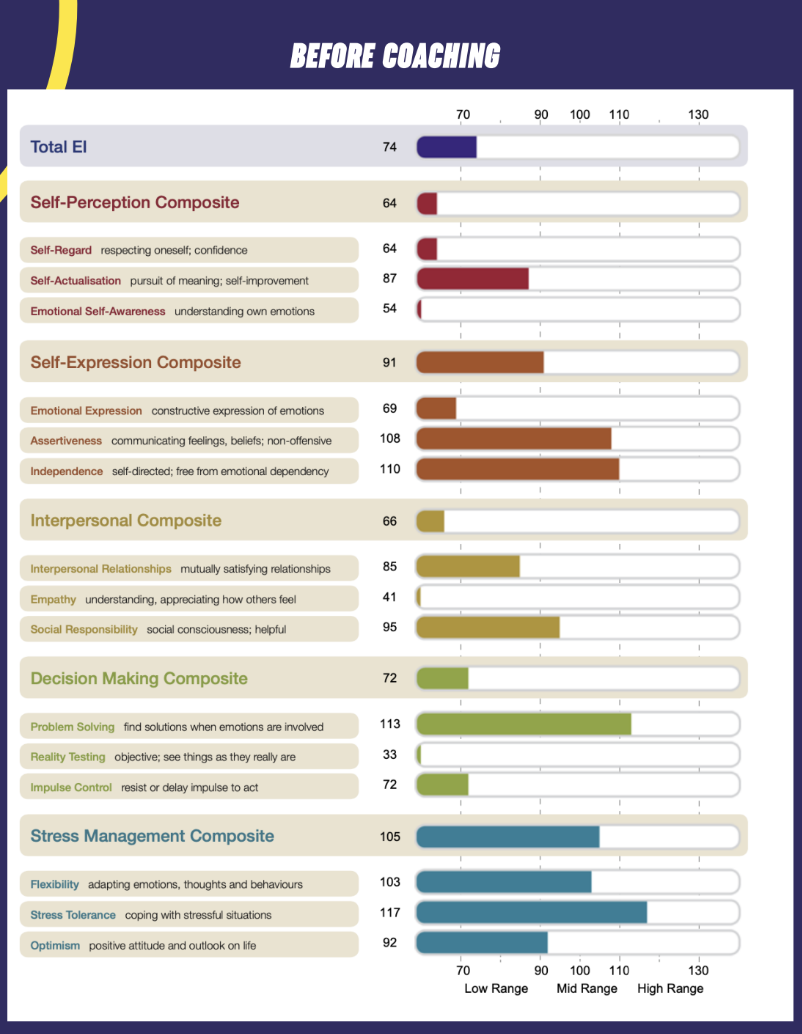
Two things stand out.
First, the shape: the 'before' chart is jagged, with a handful of long bars and three almost empty ones.
The 'after' chart is even, with every composite above average.
Second, the bars that grew most are the ones that were shortest.
Seeing things objectively moved from 33 to 90, and empathy from 41 to 83. Coaching didn't polish what Duncan was already good at; it filled in what was missing.
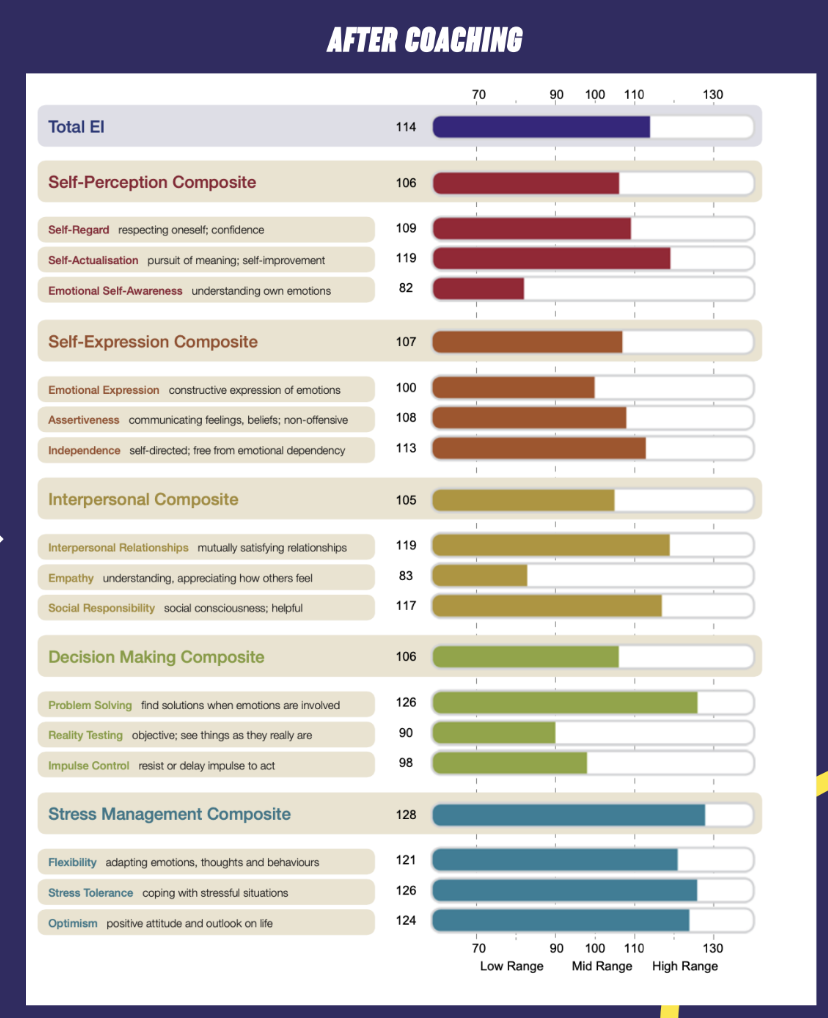
By the end of the programme, his overall score had risen to 114. Every area of his profile improved, and the three areas holding him back most: reading himself, reading others and reading the situation, showed the biggest gains.
The overall shift
Duncan was never short on drive or resilience. What changed was his ability to see clearly. Once he could read himself, his team and the situation accurately, everything else he was already good at started working properly.
Treat headline ROI claims carefully
Large percentage returns can be persuasive, but they are only useful when the source, method and context are clear.
Before using a figure in a proposal, check whether it measures emotional intelligence training, executive coaching or another intervention. Ask how the financial benefit was calculated and what other changes influenced it.
Your organisation’s own costs and priorities are a stronger starting point than an impressive percentage taken from another business.
Build the case around your own costs
Look at three areas:
Retention. Estimate the cost of recruiting, onboarding and supporting a replacement, including lost productivity. Use exit feedback to understand which departures may relate to management or working relationships.
Conflict. Include management time, absence, formal procedures and the wider effect on the team. Research prepared for Acas estimated annual UK workplace conflict costs at £28.5 billion using pre-pandemic data.
Commercial performance. Consider avoidable errors, customer retention and the quality of sales or service conversations. Use your own baseline and distinguish revenue from profit.
Find the right budget holder
The relevant budget may sit outside learning and development. A retention problem may belong to operations; a change-management challenge may sit with a transformation programme.
Involve the person responsible for the outcome early. Show the cost of the problem and explain how the proposed learning could contribute to improving it.
Summit is often commissioned directly by CEOs and Operations Directors seeking better communication, collaboration and performance.
A simple break-even calculation
The Acas report provides historical cost estimates for context. These are not current prices or savings that training will automatically deliver:
For illustration, a £10,000 programme would more than cover its cost if it prevented a replacement costing £30,614. That is a scenario to test, rather than proof that training will prevent a resignation.
Use your programme quote and actual costs, include participants’ time and avoid counting the same benefit twice.
Agree what success looks like
Start with one question:
What value do we most want this programme to deliver?
Translate the answer into specific outcomes, such as clearer feedback, fewer avoidable escalations or better collaboration between departments.
The Kirkpatrick evaluation framework helps distinguish participants’ reactions from learning, changes in behaviour and organisational results.
Agree targets with the budget holder before training begins. Afterwards, review the evidence against those expectations.
Be realistic about attribution. Training may contribute to a result alongside changes in leadership, workload, systems or market conditions.
Establish a baseline
Measure the starting point before delivery so that you have something meaningful to compare.
Useful sources include:
Exit interview themes.
Manager feedback and 360-degree reviews.
Grievance and disciplinary case numbers.
Relevant engagement-survey results.
Where appropriate, add a validated assessment such as the EQ-i 2.0 or MSCEIT. Agree a follow-up period that allows people to practise, rather than relying only on end-of-course feedback.
What helps the learning last?
Clear objectives, relevant practice, skilled facilitation and follow-up give participants a better opportunity to use what they learn.
Ask how the programme will address your workplace challenges and how participants’ managers will support them afterwards.
How Summit supports continued development
Summit designs learning around the organisation’s goals and the situations participants need to handle.
Programmes draw on the EQ-i 2.0 framework, with assessment where appropriate and practical work on relevant emotional and social skills.
Before training, we clarify the outcomes and prepare participants. Afterwards, self-paced online resources help them revisit the learning as they apply it.
The aim is continued improvement in everyday behaviour, supported by clear expectations and opportunities to practise.
Talk to Summit about your training goals
Further reading
Exploring evidence in more detail
For readers who would like to explore the evidence in more detail:
Hodzic, S., Scharfen, J., Ripoll, P., Holling, H. and Zenasni, F. (2018). How efficient are emotional intelligence trainings: A meta-analysis. Emotion Review, 10(2), 138–148. https://doi.org/10.1177/1754073917708613
Mattingly, V. and Kraiger, K. (2019). Can emotional intelligence be trained? A meta-analytical investigation. Human Resource Management Review, 29(2), 140–155. https://doi.org/10.1016/j.hrmr.2018.03.002
Hölzer, M., Kösters, M. and colleagues (2024). Training emotional competencies at the workplace: A systematic review and meta-analysis. BMC Psychology, 12, Article 725. https://doi.org/10.1186/s40359-024-02198-3 — free full text.